


Determination of visual acuity
How we measure your visual acuity depends entirely on the conditions of your eyes. If you have a normal eye, i.e. emmetropia, the visual acuity is determined without any correction. In the case of a short-sighted eye, i.e. myopia, as well as a long-sighted eye, i.e. hyperopia or a corneal curvature, we achieve the best visual acuity with corrective lenses to compensate for the defective vision. We can determine whether defective vision is present using the following measurement methods:
Objective refraction
Using a so-called autorefractometer, the refractive values of the optical correction - in most cases glasses - can be determined. This allows us to improve visual acuity and the eyes examined can also see clearly in the distance. The measured values are based on the instrumental measurement. This means that in this case, we do not use corrections to determine when your vision is better, but evaluate the sharpness based on the measurement alone.
Subjective refraction
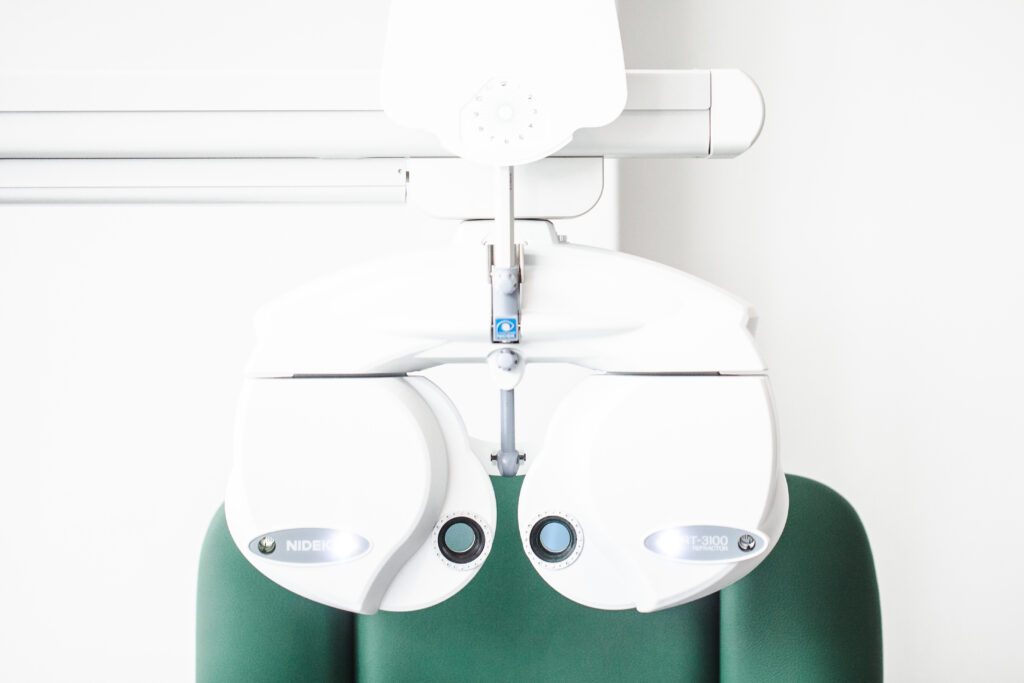
The subjective refraction is a fine adjustment of the refractive values of the optical correction. It is almost always based on the objective refraction, which we have explained above. This serves as the starting value for the subjective refraction. This depends on the co-operation and ability to provide information of the person being examined, i.e. you tell us which correction you can see better with.
Determining visual acuity in children
Determining visual acuity in children is a particularly important task that we take very seriously at BeyondEye. As children can still focus very strongly on objects at different distances - in technical jargon this is called accommodation - cycloplegia is often necessary for an accurate measurement of refraction. This involves temporarily paralysing the ciliary muscle required for accommodation with eye drops. This allows us to determine visual acuity without the child being able to accommodate. This examination is carried out at our vision school by specially trained professionals in a child-friendly environment.
Good to Know
What does visual acuity mean?
Visual acuity is the measure of your ability to recognise patterns and contours. As described above, there are various methods for determining this. In ophthalmological practice, various visual acuities are also available for this purpose (e.g. numbers, letters, rings, symbols). These visual acuities have been standardised in terms of their size and distance from each other and are assigned to certain levels of visual acuity. We usually state your visual acuity in per cent or in decimals. A visual acuity of 1.0 corresponds to 100 per cent. It is quite normal for young patients with healthy eyes and optimal spectacle correction to achieve a visual acuity of 120 to -160 per cent. The expected visual acuity is therefore definitely age-dependent and can be influenced by various eye diseases.
What does visual acuity mean?
Visual acuity is the measure of your ability to recognise patterns and contours. As described above, there are various methods for determining this. In ophthalmological practice, various visual acuities are also available for this purpose (e.g. numbers, letters, rings, symbols). These visual acuities have been standardised in terms of their size and distance from each other and are assigned to certain levels of visual acuity. We usually state your visual acuity in per cent or in decimals. A visual acuity of 1.0 corresponds to 100 per cent. It is quite normal for young patients with healthy eyes and optimal spectacle correction to achieve a visual acuity of 120 to -160 per cent. The expected visual acuity is therefore definitely age-dependent and can be influenced by various eye diseases.